Clear ownership
Connect each event with a reviewer and responsible team.
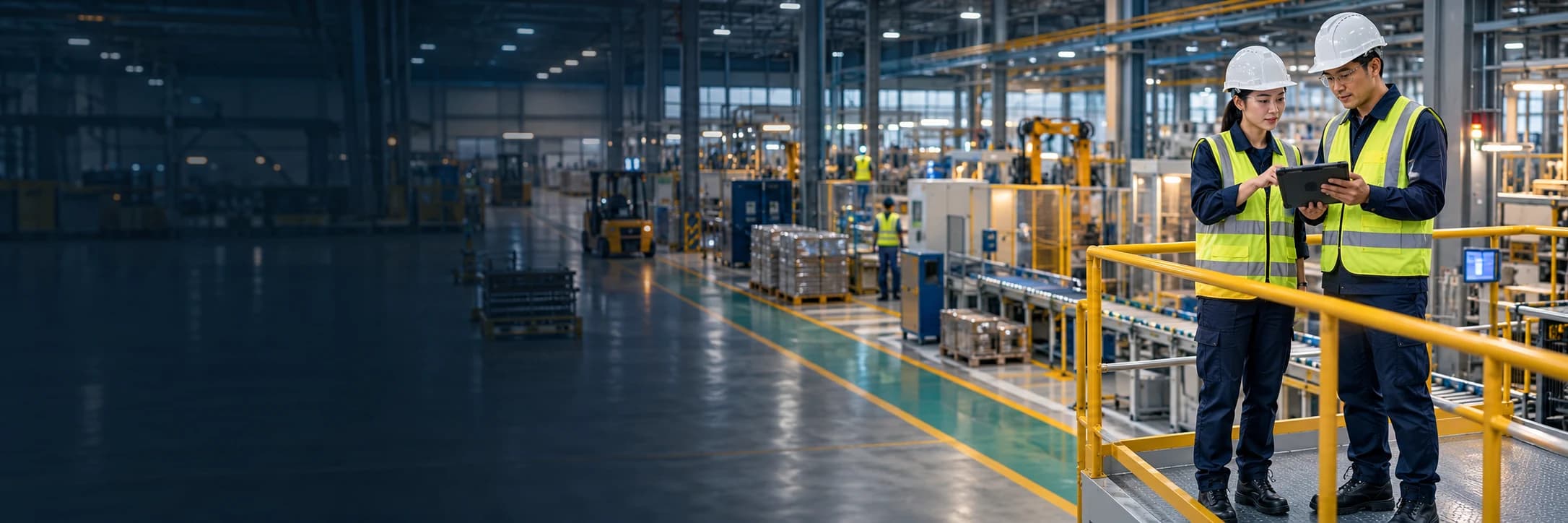
Connect risk detection, event review and corrective actions across construction, manufacturing, logistics and operating facilities.
Smart Safety connects camera data with safety and operations teams through an accountable cycle: identify signals, review context, assign responses, verify outcomes and learn from the findings.
Construction scenarios address protective equipment, work zones and lifting activities within an agreed scope. Manufacturing, warehouse and port scenarios are selected around equipment, internal traffic and local operating procedures.
Existing AI capabilities use on-site processing, HeraMind and AI Vision Platform within validated configurations. Corrective actions, inspections, work permits and sensor data are extensions requiring assessment, workflow design or integration.

HSE/EHS teams retain review and decision responsibilities. Smart Safety supports data, coordination and records through corrective action.
Identify helmets, reflective vests and selected area-specific protective equipment. Eyewear, gloves, footwear and specialized protection require adequate image detail and field validation.
Configure zones, boundaries and schedules for restricted-area entry signals. Responsible reviewers check imagery before classification and response.
Review pedestrians, forklifts and vehicles within configured zones. Distance, speed and near-miss scenarios require calibration or a PoC; alerts are not an automatic braking system.
Select viewpoints around open edges, suspended loads and lifting areas. Detection depends on visibility, occlusion and processing capacity, validated in a pilot.
Configure selected fall, person-down or smoke/fire scenarios. Signals require review and do not replace dedicated fire detection, gas instruments or emergency response systems.
Design records with imagery, time, location, priority, ownership and verification. Assignment, deadlines and closure are configured or integrated around organizational processes.
Assess inspection forms, work prerequisites and approval levels. This is an extension with agreed signatures, validity periods and authority before digitization.
Summarize reviewed events by area, shift or team, with access and retention controls. Sensor, speaker, management-system and API connections are assessed and scoped separately.
Select an industry to explore assessment needs and delivery scope. Each scenario requires suitable data, configuration and pilot criteria.
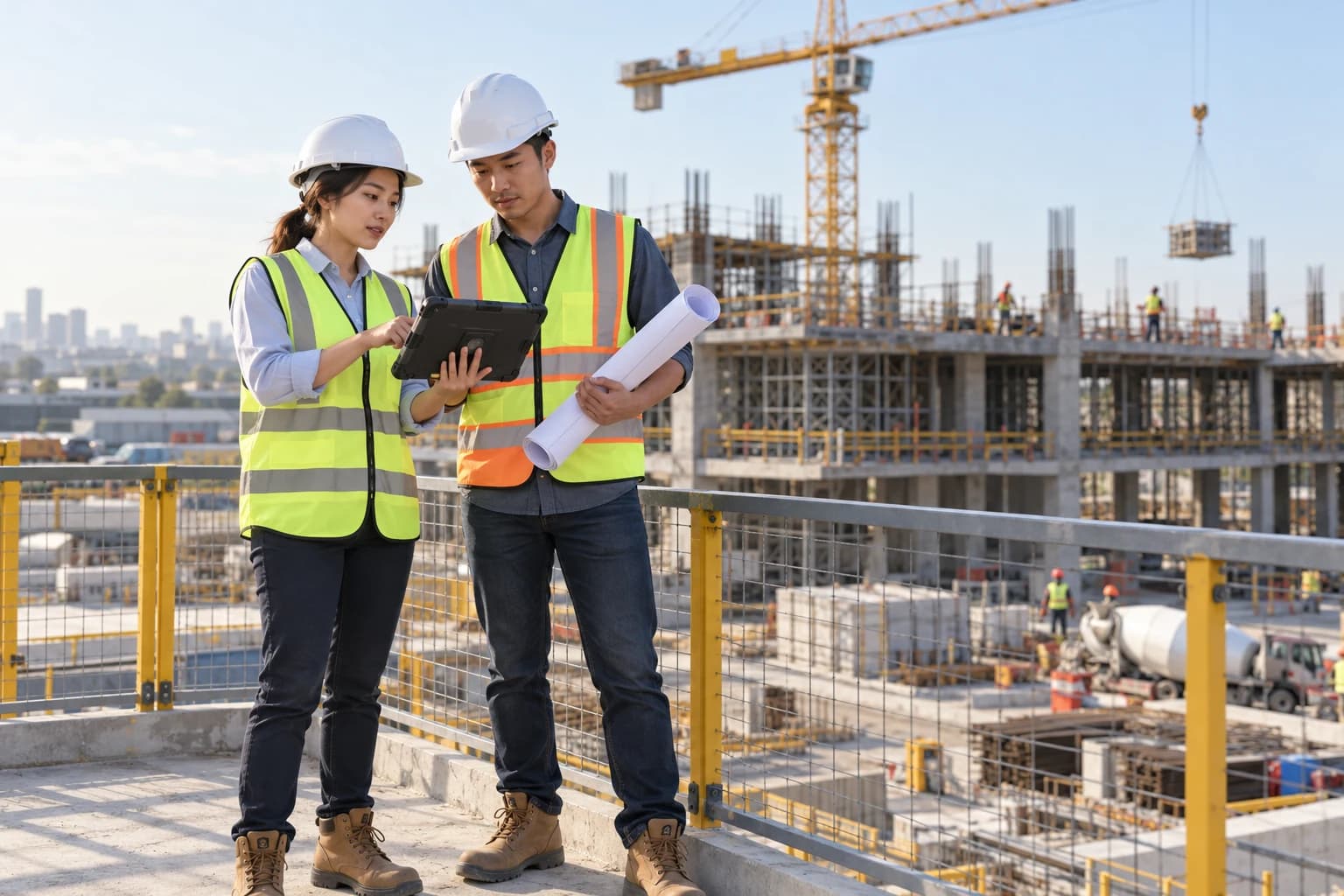
Configure by work zone, phase and responsible team so alerts reach the people who can respond.
Proposed scope: zone-specific AI plus site review and response workflows.
Discuss this applicationAI-generated images illustrate application contexts rather than customer engagements.
This illustrates a proposed management workflow. Forms, approval roles and work-assignment connections are agreed within delivery scope.
Cameras or data sources raise signals against selected zones and rules.
Reviewers check imagery, time and context before classification.
Assign actions to the right team with requirements and response targets.
Review responses and corrective evidence before closure.
Use reviewed records to prioritize inspections and process changes.
Review response quality and verified events rather than alert volume alone.
Connect each event with a reviewer and responsible team.
Link imagery, timestamps and responses for review.
Review responses and evidence instead of counting alerts alone.
Use verified trends to select areas for attention.
Set access and responsibilities by area, shift or contractor.
Pilot an area before adding cameras, modules or integrations.
Suitable cameras, on-site processing, HeraMind/AI Vision Platform and modules selected after a PoC.
Assignments, inspections, work permits and tailored reports are designed or integrated within scope.
Sensors, wearables, speakers, controllers and system connections require compatibility review and separate pricing.
Check cameras/NVRs, RTSP/ONVIF, networks, lighting and risk areas. Select suitable AI tasks for each camera.
Test real footage and tune models and zones; agree on supported scenarios and operating limits.
Connect Edge AI to HeraMind/AI Vision Platform, configure mobile alerts and train operators to review events.
Train, resolve issues and hand over. Add cameras or tasks based on validated Edge capacity and an agreed quotation.

Explore AQPTech’s brochure on AI for industrial safety. Open the PDF or download a copy to share with your team.
PDF · 10 pages · 2.2 MB · Vietnamese
Videos illustrate detection capabilities, not the complete management extensions or performance guarantees.
An illustration of people, helmet and vest detection for safety review.
An illustration of scenarios for review where people and vehicles operate together.
The table retains existing reference rates for AI licenses, hardware and setup. Management workflows, work permits, sensors and specialized integrations are assessed and quoted separately; obtain a current quotation for prices and validity.
Choose AI tasks for each camera. Recurring AI licensing, Edge hardware and initial deployment are itemised separately for clear budgeting.
One free month of AI licensing, equivalent to 16.67% savings. Hardware, deployment and special customisation are excluded; promotions do not automatically stack.
| AI plan | Features & conditions | VND / camera / month | VND / camera / 6 months |
|---|---|---|---|
| Basic AI | Person detection, unauthorised intrusion and line crossing. Requires a stable camera view. | 387,000 | 1,935,000 |
| Entry Compliance | Face recognition, attendance, PPE and speaker scenarios. Speaker hardware/integration depends on the survey; sub-second processing requires a PoC. | 1,347,000 | 6,735,000 |
| Protective Uniform & PPE | Hard hats, protective clothing and basic PPE vests. Glasses, gloves and shoes require enough image detail; specialist PPE is evaluated separately. | 747,000 | 3,735,000 |
| Face Recognition | Face recognition and attendance software. Suitable WDR and face angles are required. | 1,047,000 | 5,235,000 |
| Traffic Safety | Vehicles, forklifts and safe traffic zones. Speed and phone use while driving require calibration and a PoC. | 1,047,000 | 5,235,000 |
| Industrial Safety | PPE, danger zones and suspected fall/accident situations. Height work, lifting, person-down and specialised rules require a PoC. | 1,347,000 | 6,735,000 |
| Industrial Safety+ | Visual smoke/fire, specialist PPE and tailored monitoring. Specialist PPE requires data and a PoC; visual fire detection does not replace dedicated alarms. | 1,647,000 | 8,235,000 |
Reference prices from the quotation dated 18 September 2026, valid for 30 days. Taxes and final scope are confirmed in the formal quotation.
Reuse existing cameras. Both models use ROC-RK3588-RT, RK3588, a 6 TOPS NPU and Linux; quantities are confirmed after load benchmarking.
16GB RAM · NVMe 512GB
Target: 4–8 standard AI streams or 2–4 demanding streams/box. The 30-camera reference uses four E8s; capacity and SLA are agreed after a PoC.
12-month warranty8GB RAM · NVMe 256GB
Target: 1–4 standard AI streams/box; benchmark demanding tasks. Optional according to network topology and redundancy needs.
12-month warrantyStandard reference: one site, up to 30 cameras, up to three standard AI groups and four Edge AI boxes. One-time service charge.
| Service | Amount (VND) |
|---|---|
| Camera/NVR/network survey and RTSP/ONVIF checks | 3,000,000 |
| Install four Edge AI boxes and connect existing cameras | 8,000,000 |
| Configure HeraMind / AI Vision Platform / mobile alerts | 5,000,000 |
| AI model tuning and PoC by area/use case | 12,000,000 |
| Training, remediation and handover | 4,000,000 |
| Deployment total | 32,000,000 |
Four Edge AI E8 units plus standard deployment. Final sizing depends on the survey and PoC results.
Excludes recurring AI licensing, VAT and optional items. AI fees are calculated separately using camera counts and the selected plans above.
Tell us about your industry, risk areas and workflows to improve.
Loading form…
Signals are connected to review, response ownership and corrective records. Cameras and AI provide the data layer; management workflows are configured or integrated for the organization.
No. Assessments can cover factories, warehouses, energy, chemicals, ports and facilities. Each industry needs its own risk selection, data and pilot criteria.
Not necessarily. Review accessible streams, viewpoints, lighting and image detail per task. Additional equipment is proposed when the assessment supports it.
Not by default. These workflow extensions need agreed forms, roles, approvals and integrations, with separate scope and pricing.
No. Responsible teams review signals, assess context and decide actions. The tools support observation and records, not a replacement for on-site safety processes.
Not by default. Camera observation does not imply automatic braking or machine control. Device actuation requires a separately assessed architecture, latency and engineering process.
Vision modules detect signs within tested conditions. Gas measurement and dedicated fire alarms require appropriate equipment; sensor integrations are assessed separately.
Agree area and role-based access, retention, alerts and sharing. On-site or centralized processing follows infrastructure and data policies.
Reference pricing separates camera-based licenses, hardware and setup. Extensions, specialized data and integrations are quoted separately, with current scope confirmed in a formal quotation.
Prepare industry context, risk areas, cameras, sample footage, shift conditions and reviewers. Agree true/false alert definitions, response times and acceptance criteria before testing.
At AQPTech, we connect people, technology and real-world challenges. Learn together, grow your skills and build solutions that create value for businesses.

Find your next step with AQPTech
Explore career opportunitiesPowering Decisions