Live View
Monitor cameras by site, device group, map, or video wall with flexible layouts, PTZ, audio, and AI metadata overlays.
AQP Vision™ Platform connects cameras, recorders, Edge AI devices, and storage in one interface. Organisations can manage live monitoring, recording, video search, AI events, and system health across cloud, on-premise, or hybrid deployments without replacing their entire camera estate.
Organisations running cameras from several brands across one or many sites, who want unified monitoring, video search and AI alerts on a single system without replacing the hardware they already own.
If you recognise yourself in the description below, this is the right solution to look at.
Cameras, NVRs, and software from different vendors operate in site-level silos
Incident search and verification still rely on manual footage review
Large alert volumes lack consistent priority, ownership, and response workflows
Camera, server, storage, and network health is difficult to monitor centrally
AI, access control, IoT, and business systems do not share operational context
Adding storage, users, and sites increases operational complexity
These are the concrete changes in day-to-day work once the system is running.
Protect existing camera and recorder investments
One operating centre for live video, AI, events, and system health
Faster incident search, verification, and response
Lower bandwidth and latency through edge AI and tiered storage
Scale from one site to distributed operations without single-vendor lock-in
Turn video events into enterprise data and workflows
All of it is configured by us around your existing setup before handover.
Monitor cameras by site, device group, map, or video wall with flexible layouts, PTZ, audio, and AI metadata overlays.
Record continuously, by schedule, motion, or event; synchronise multi-camera playback and preserve pre/post-event video.
Ingest people, vehicle, behaviour, and anomaly analytics from AI cameras, Vision Edge, or CVEDIX AI pipelines.
Detect people missing a hard hat, hi-vis vest, harness, mask, or gloves — only inside the zones and shift hours you configure, so nothing fires outside working time. Every violation carries a timestamped snapshot and rolls up into a compliance rate by day, by area, and by crew.
Unify alerts, snapshots, video clips, priority, ownership, status, comments, and the complete response audit trail.
From hours of video to the events that matter: search by person, vehicle, time, area, event type, direction, line crossing, intrusion, or loitering, using authorised metadata.
Track cameras online/offline, recording status, storage, stream health, network connectivity, device status, and events — so you know the system is fully working before you need the footage.
For estates that already have cameras but no AI: feed existing RTSP streams through an AQP AI appliance to add event detection without replacing the hardware.
Keep video at the edge or on-premise while cloud services centralise health, events, dashboards, and remote access.
Connect ONVIF, RTSP, SDKs, APIs, webhooks, MQTT, access control, IoT, and enterprise systems; connectors for third-party VMS can be developed per project.
Protect perimeters, monitor PPE and hazardous zones, and combine video events with IoT or maintenance data.
Monitor warehouses, number plates, gates, and deliveries, with investigation supported by WMS/TMS context.
Manage stores, people counting, queues, heatmaps, POS integration, and remote investigations.
Unify cameras, parking, access control, intercom, and BMS by property, floor, or functional area.
Classify vehicles, recognise number plates, understand traffic density, and display incidents on operational maps.
Support hierarchical administration, long retention, audit trails, strict permissions, and local data deployment.
Baseline detection comes with every cloud plan; the rest are switched on per camera. Each card states what the classifier is asked to find and, where it matters, the boundary you draw so it cannot fire anywhere else.
Boxes each person and vehicle in the frame. This is what makes a recording searchable: you jump to the moment something moved instead of scrubbing an hour of an empty yard.
Checks each worker inside a zone you draw for a hard hat, hi-vis vest and harness, and only during the shift window you set — so nothing fires on an empty site at night. Harness is the hardest of the three to see, so its camera position is confirmed during the survey.
Compares a face in the frame against the people you have enrolled and raises the ones on a watch list. The similarity threshold is tuned per site during the survey rather than shipped as a fixed figure.
Reads the plate as a vehicle passes and hands the characters to a barrier, a car park, or your ERP. A minimum and maximum plate size keeps the rule off vehicles too far away to read reliably.
Reads printed text in the picture — container numbers, pallet and product codes, signage — so what the camera saw can be reconciled against a delivery note without anyone typing it in.
Answers a written question with ranked stills instead of a timeline: "a person in a red shirt between 2pm and 4pm" gives you the frames worth checking first.
The screens themselves are in the section below. Which capabilities a given camera can run depends on its position, resolution and lighting, and is settled during the site survey.
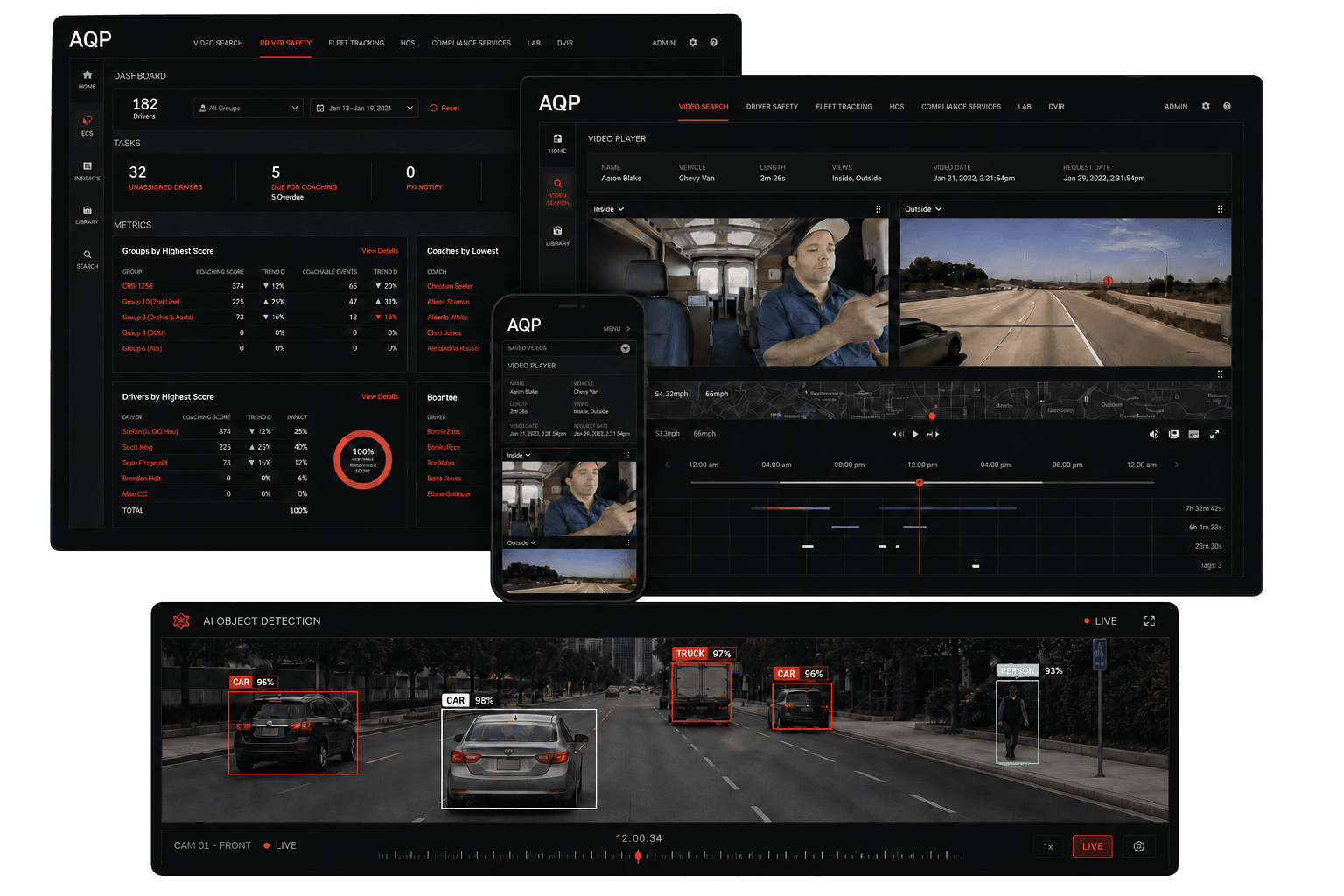
Captures from AQP Vision™ Platform: the monitoring wall, the recording timeline, video search, and the AI rule configuration applied per camera.
Captured from a test system; faces and number plates in these images are blurred. Which AI classifiers are available depends on camera configuration and the scope of each deployment.
These names describe capability groups within AQP Vision™ Platform, not separate product brands.
Live view, recording, playback, maps, video walls, and central management of cameras, users, and sites.
Video AI for security, people, vehicles, safety, and operations under confirmed solution packages.
Metadata, attribute, reference-image, and multi-camera object journey search.
Multi-site health, events, configuration, and remote access with flexible video-retention policies.
Gateway, recording, and AI close to the source to reduce bandwidth, latency, and internet dependency.
APIs, SDKs, webhooks, and connectors for device ecosystems and enterprise software.
Monitor cameras, streams, servers, storage, recording gaps, certificates, and scheduled health reports.
View live and recorded video and respond to alerts on mobile under the same access policy.
Cloud plans carry published prices, from 49,000₫ per camera per month, and can be used straight away for a single store or facility. The five licence packages below are for multi-site estates: cost depends on scale, how recordings are stored, and the support level, so we survey first and then quote — the survey is free.
Live view, recording, playback, users, basic maps, and device alerts for smaller systems.
Multi-site/server operations, Event Centre, Rules Engine, health, APIs, and Edge AI integration.
Adds Video AI, Deep Search, AI Event Management, and dashboards for confirmed use cases.
Distributed architecture, HA, hybrid/private cloud, multi-tenancy, SSO, custom integrations, and SLA.
White-label, APIs/SDKs, connectors, and project or subscription licensing for SIs and partners.
Device compatibility and feature status are confirmed during survey or PoC. Search scope and AI event types depend on image quality, what the camera or AI device can produce, and the package agreed — not every search criterion is available on every system. Advanced Deep Search, natural-language search, high availability, SSO, Vision Mobile, the AI Video Appliance for older cameras, third-party VMS connectors, direct-to-cloud cameras, and vendor-specific NVR support may be add-ons, in development, partner integrations, or project customisations.
No. It is designed for multi-vendor cameras through compatible ONVIF, RTSP, API, or SDK connections.
Potentially. Compatibility depends on each NVR/DVR protocol and API and is assessed before solution design.
No. Video can remain on-site while the cloud receives selected health, metadata, events, snapshots, or clips.
Existing streams can be processed through an AI server or Vision Edge, subject to image quality and the analytics required.
Yes where compatible metadata is available; search scope depends on the AI package and image quality.
Yes. Deployment options include cloud, private cloud, on-premise, and hybrid architectures.
AQP Fleet™ One can supply incident video, vehicle location, and journey context to the operations centre.
Yes. SIs and partners can deploy the platform under their own brand under an OEM agreement.
This part is for your IT team. If you do not need it, skip it — we handle this side.
Multi-vendor IP cameras, NVRs/DVRs, access control, sensors, alarms, and vehicle video sources.
→AQP Video Gateway or edge appliances handle discovery, buffering, recording, and AI inference near the source.
→AQP's media core manages live streams, transcoding, playback, clips, and hot, warm, and archive storage tiers.
→Central management for devices, users, metadata, maps, events, rules, Deep Search, and System Health.
→Vision Connect synchronises events with AQP Fleet™ One, AQP Construction™, and business systems through APIs.
Tell us how many locations or how many vehicles, and we will survey and send an approach with pricing.
Request a demo↗Share the current state of your systems, your workflow, and the objectives that matter most. The AQP team will help scope it and propose a PoC to start from.
Leave your details and our team will respond shortly.